My Addresses
+ Add AddressNo saved addresses found.
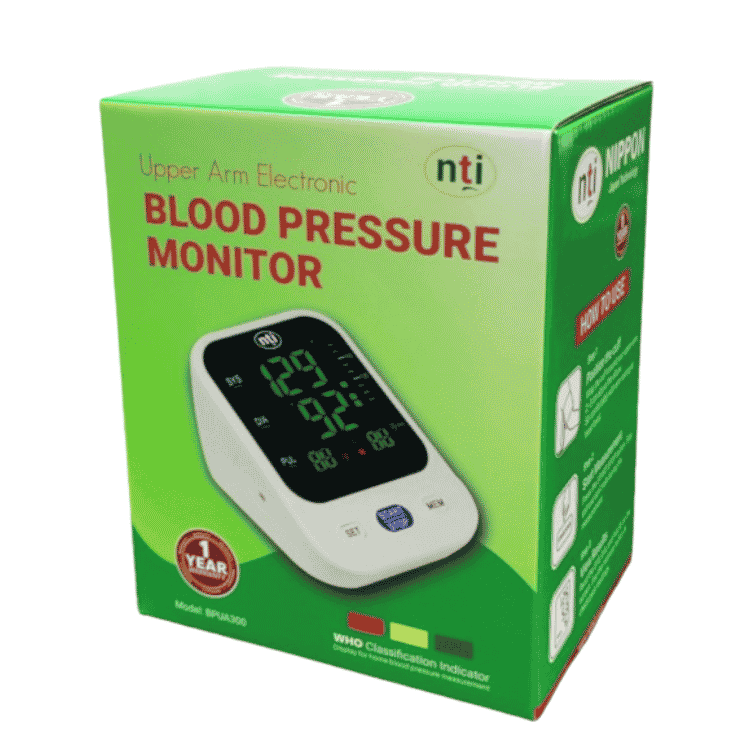
The NTI Nippon Blood Pressure Monitor (Model BPUA200) represents a significant advancement in home diagnostic technology. Engineered as a high-precision digital tool, it is designed to bridge the gap between professional clinical monitoring and daily home health management. As hypertension remains a leading "silent killer" globally—contributing to strokes, heart attacks, and kidney failure—the BPUA200 serves as a critical first line of defense. By utilizing sophisticated Japanese integrated technology, this upper-arm monitor offers users a reliable way to track their cardiovascular health with the same level of accuracy once reserved for medical facilities.
Beyond simple measurement, the BD series (including the BPUA200) is designed with biological data integration in mind. It serves not only as a measurement device but as a data logger that facilitates longitudinal health tracking, allowing for a more nuanced understanding of a patient's cardiovascular profile over weeks or months.
The BPUA200 operates using the oscillometric method of measurement. Unlike the traditional auscultatory method (which requires a stethoscope to listen for Korotkoff sounds), the oscillometric method detects the vibration of blood traveling through the arteries as the cuff deflates.
Inside the BPUA200, high-sensitivity pressure sensors capture these oscillations and convert them into digital signals. The internal Japanese-engineered algorithm then calculates the Systolic and Diastolic pressures based on the magnitude of these vibrations. This method is preferred for home use because it eliminates human error associated with hearing and manual timing, providing a consistent baseline for long-term health tracking. The integration of advanced Digital Signal Processing (DSP) allows the device to filter out "noise" created by minor muscle movements, ensuring that the final reading is reflective of true arterial pressure.
The BPUA200 is characterized by a sleek, ergonomic profile that prioritizes ease of use for a demographic that may include elderly patients or those with limited dexterity.
The device features a large, high-contrast liquid crystal display (LCD) measuring approximately 7 cm x 5 cm. This screen is designed to be legible under various lighting conditions, displaying the systolic pressure, diastolic pressure, and pulse rate in oversized digits. Additionally, the screen features intuitive icons for battery life, memory bank status, and irregular heartbeat detection. The backlight is calibrated to prevent glare, making it suitable for use in both bright daylight and low-light evening environments.
Simplicity is central to the BPUA200 design. It utilizes a "Clear Light" button system. By minimizing complex menu navigation, the device allows for a "one-touch" measurement cycle. Once the cuff is applied, the user simply presses the primary start button, and the device handles the inflation, measurement, and deflation automatically. This reduced cognitive load is essential for patients who may feel anxious during testing, which can otherwise lead to skewed results.
The BPUA200 is built to operate within strict medical-grade tolerances to ensure user safety and data integrity:
Pressure Range: 30 mmHg to 280 mmHg (covers hypotensive to severely hypertensive states).
Pulse Range: 40 to 199 beats per minute.
Static Accuracy: Pressure within ±3 mmHg; Pulse rate within ±5% of the displayed value.
Memory Capacity: 90 measurement slots with time and date stamps for trend analysis.
Inflation/Deflation: Fully automatic micro-pump inflation and an electronic rapid exhaust valve.
Power Management: Dual-source capability. It accepts 4 x AA alkaline batteries for wireless portability or a 6V AC adapter for continuous, battery-free operation.
To achieve results comparable to a doctor's office, users must adhere to a standardized protocol when using the BPUA200:
Physical Preparation: Avoid caffeine, alcohol, and nicotine for 30 minutes. Sit quietly for 5 minutes before beginning. Ensure the bladder is empty, as a full bladder can raise blood pressure by 10-15 mmHg.
Posture: Sit upright in a chair with back support. Keep feet flat on the floor (do not cross legs). The arm should be relaxed and unconstrained by tight clothing.
Cuff Placement: Place the cuff on the bare left arm (ideally), 1-2 cm above the elbow. Ensure the air tube is centered on the inside of the arm, following the path of the brachial artery.
Height Alignment: The cuff must be at the same level as the heart. Use a table to support the arm if necessary. If the arm is too low, the reading will be falsely high; if too high, the reading will be falsely low.
To maintain the BPUA200's accuracy over years of service, the device should be kept in its protective case when not in use. The cuff should be inspected periodically for leaks, and the LCD screen should be cleaned only with a dry, soft cloth. Because the device uses precise electronic components, it should be stored away from extreme temperatures, high humidity, and direct sunlight, all of which can degrade the sensor sensitivity.
The NTI Nippon BPUA200 is an essential tool for modern health management. By combining the precision of Japanese integrated circuits with user-centric features like WHO indicators and 90-set memory storage, it empowers users to move beyond sporadic check-ups. It provides a comprehensive, data-driven view of cardiovascular health, enabling more informed conversations between patients and their healthcare providers. In an era of personalized medicine, the BPUA200 stands as a reliable, clinical-grade companion for anyone serious about their long-term well-being.
No reviews yet. Be the first to review!
Your cart is empty

.png)
.png)
.png)
.png)
.png)
 Upload Prescription
 Prescription Medicine
 Food & Nutrition
 Diabetic Care
 Diapers
 Dental Care
 Home Care
 OTC Medicine
 Healthcare Device
 Sexual Wellness
 Mother and Baby
 Herbal
 Personal Care
 Surgical



.png)
.png)