My Addresses
+ Add AddressNo saved addresses found.
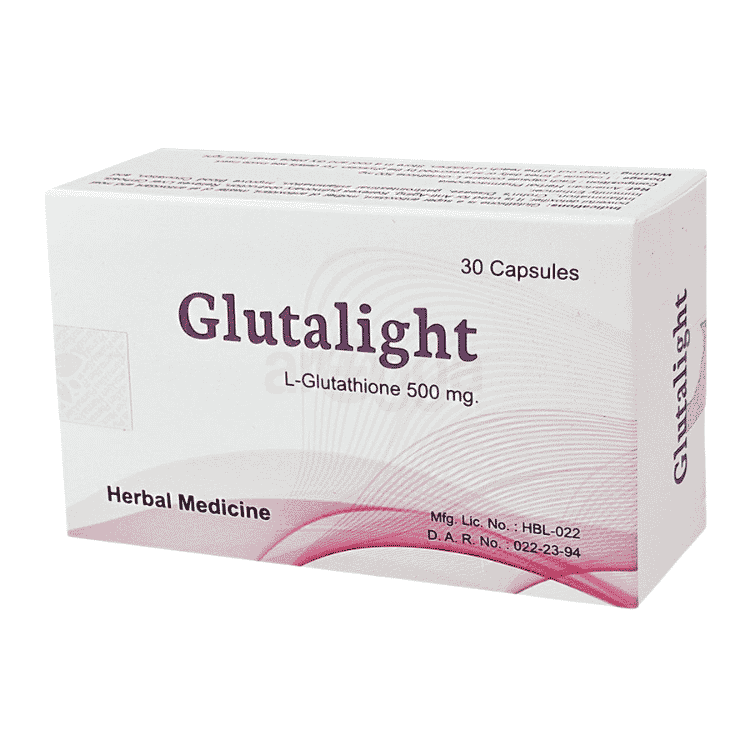
Glutalight-L is a premium, therapeutic-grade antioxidant and dermatological formulation designed to support systemic detoxification, cellular defense, and skin-brightening pathways. Centered around a high-potency dose of reduced L-Glutathione (500 mg), this preparation is clinically engineered to combat oxidative stress, modulate melanogenesis, and promote cellular rejuvenation. It is typically supplied in oral solid dosage forms (tablets or capsules) designed to maximize systemic bioavailability and therapeutic efficacy.
Each capsule or tablet of Glutalight-L is formulated with a highly purified, biologically active matrix:
Reduced L-Glutathione (GSH) (500 mg): The tripeptide master antioxidant consisting of glutamic acid, cysteine, and glycine. Only the reduced form (GSH) possesses the free thiol group (-SH) necessary to donate electrons, neutralize free radicals, and participate in metabolic detoxification pathways.
Ascorbic Acid (Vitamin C) (250 mg): A crucial synergistic cofactor that maintains glutathione in its active, reduced state. It acts as an electron donor to regenerate oxidized glutathione (GSSG) back into GSH.
Alpha Lipoic Acid (ALA) (50 mg): A universal fat- and water-soluble antioxidant that works in tandem with Vitamin C and GSH to sustain the intracellular antioxidant network and improve mitochondrial energy output.
Glutalight-L exerts its therapeutic effects through precise biochemical interactions at both the systemic cellular level and within the epidermal layers.
The primary mechanism by which L-glutathione mediates skin brightening is through the modulation of the melanin synthesis pathway in epidermal melanocytes:
Tyrosinase Inhibition: GSH directly binds to the active copper-containing site of the tyrosinase enzyme, inhibiting its ability to convert L-DOPA into dopaquinone—the initial step in melanin production.
Melanogenesis Pathway Shift: GSH reacts with dopaquinone to form cysteinyldopa. This shifts the synthesis of dark, highly visible eumelanin (the pigment responsible for brown or black skin tones) toward the production of lighter, yellow-red pheomelanin.
Scavenging of Reactive Oxygen Species (ROS): Ultraviolet (UV) radiation generates ROS that trigger melanocyte-stimulating hormone (\alpha-MSH) and upregulate tyrosinase. By neutralizing these ROS, Glutalight-L downregulates the inflammatory cascade that drives post-inflammatory hyperpigmentation (PIH).
As the body's primary intracellular antioxidant, GSH serves as a substrate for the enzyme Glutathione Peroxidase (GPx), which reduces harmful hydrogen peroxide (H₂O₂) and lipid hydroperoxides into harmless water (H₂O) and alcohols:
2GSH + H_2O_2 \xrightarrow{GPx} GSSG + 2H_2O
Furthermore, in the liver, GSH participates in Phase II conjugation. It binds to xenobiotics, heavy metals, and acetaminophen metabolites via Glutathione S-Transferases (GST), converting them into water-soluble mercapturic acids that are safely excreted through the renal pathway.
Glutalight-L is indicated as a primary or adjunctive therapy for:
Dermatological Hypermelanosis: Management of melasma, chloasma, post-inflammatory hyperpigmentation (PIH), solar lentigines (age spots), and uneven skin tone.
Systemic Oxidative Stress Support: Protection against cellular damage caused by chronic environmental toxin exposure, UV radiation, and lifestyle stressors.
Hepatic Support and Detoxification: Adjunctive therapy to assist hepatic clearance in cases of fatty liver disease, alcohol-induced oxidative stress, or subclinical toxic exposures.
Anti-Aging Therapies: Preservation of mitochondrial vitality and prevention of premature dermal collagen degradation.
To maintain optimal therapeutic serum levels of active L-glutathione, the following guidelines are recommended:
Standard Clinical Dosage: Take 1 to 2 capsules daily, ideally in the morning or split into two doses (morning and evening).
Optimizing Bioavailability: For enhanced gastrointestinal absorption, Glutalight-L should be taken on an empty stomach, approximately 30 minutes before a meal, or as directed by a healthcare professional.
Duration of Therapy: Due to the epidermal turnover cycle (approx. 28 days), initial dermatological improvements typically become visible after 4 to 6 weeks of consistent daily use, with optimal results manifesting after 3 to 6 months of continuous therapy.
Glutalight-L has an excellent safety profile, but key precautions should be observed:
Tolerability: The formulation is highly tolerated. Mild gastrointestinal effects, such as abdominal cramping, bloating, or loose stools, may occasionally occur at higher doses.
Contraindications: Avoid use in individuals with a known hypersensitivity to L-glutathione or any excipients in the formulation. Not recommended for pregnant or lactating women due to a lack of long-term safety data in these populations.
Interactions: Consuming alcohol reduces liver glutathione stores, which can diminish the efficacy of Glutalight-L. No severe drug interactions have been reported, but patients taking chemotherapeutic agents should consult their oncologist prior to starting antioxidant therapy.
No reviews yet. Be the first to review!
Your cart is empty

.png)
.png)
.png)
.png)
.png)
 Upload Prescription
 Prescription Medicine
 Food & Nutrition
 Diabetic Care
 Diapers
 Dental Care
 Home Care
 OTC Medicine
 Healthcare Device
 Sexual Wellness
 Mother and Baby
 Herbal
 Personal Care
 Surgical

.png)
.png)