My Addresses
+ Add AddressNo saved addresses found.
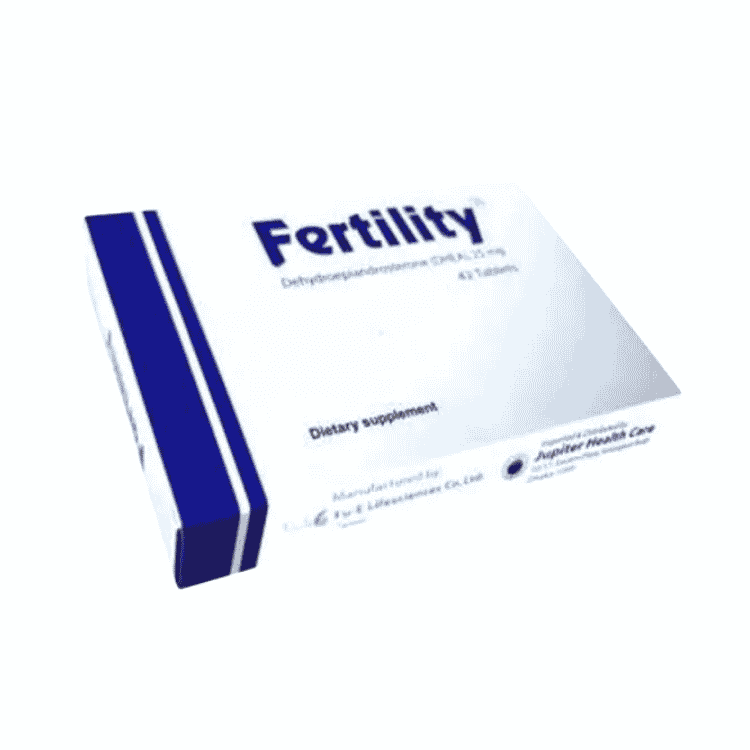
Fertility Tablet 25 mg is a specialized endocrine formulation containing micronized Dehydroepiandrosterone (DHEA) at a therapeutic strength of 25 mg. Formulated as an oral dietary supplement and metabolic precursor, this preparation is clinically utilized to address female subfertility. It is specifically indicated for women presenting with diminished ovarian reserve (DOR), poor ovarian response (POR) during assisted reproductive technologies (ART), or advanced ovarian aging.
Each tablet of Fertility Tablet 25 mg contains:
Micronized Dehydroepiandrosterone (DHEA) (25 mg): The active pharmaceutical ingredient is a naturally occurring endogenous steroid hormone synthesized by the adrenal cortex, the ovaries, and the central nervous system.
Micronization Advantage: The DHEA in this formulation is micronized (reducing particle size to less than 10 microns), which significantly enhances gastrointestinal absorption, increases systemic bioavailability, and reduces inter-patient pharmacokinetic variability.
DHEA serves as an essential intermediary upstream prohormone. It possesses weak intrinsic androgenic activity but undergoes intracellular metabolic conversion within peripheral tissues—specifically the ovarian follicular cells—to become active sex steroids.
Within the ovaries, DHEA is converted by the enzymes 3\beta-hydroxysteroid dehydrogenase (3\beta-HSD) and 17\beta-hydroxysteroid dehydrogenase (17\beta-HSD) into androstenedione and testosterone (T), which are subsequently aromatized into estradiol (E_2).
Androgens generated locally from DHEA play a fundamental role in early folliculogenesis:
FSH Receptor Expression: Androgens bind to androgen receptors (AR) on pre-antral and early antral granulosa cells. This signaling upregulates the transcription of Follicle-Stimulating Hormone (FSH) receptors.
Follicular Recruitment: Increased FSH sensitivity enhances the recruitment of primordial and primary follicles into the growing pool, preventing premature follicular atresia (programmed cell death).
IGF-1 Amplification: DHEA promotes the local expression of Insulin-like Growth Factor 1 (IGF-1), which works synergistically with FSH to stimulate granulosa cell proliferation and steroidogenesis.
Clinical studies suggest that restoring an optimal androgenic microenvironment in aging ovaries preserves mitochondrial function and spindle assembly in maturing oocytes. This helps lower the rate of chromosomal non-disjunction, thereby reducing the incidence of embryos with aneuploidy (abnormal chromosome numbers).
Fertility Tablet 25mg is primarily prescribed in reproductive endocrinology for:
Diminished Ovarian Reserve (DOR): Characterized by low Anti-Müllerian Hormone (AMH < 1.0 ng/mL) and a depleted antral follicle count (AFC).
Poor Ovarian Response (POR): Designed for "poor responders" undergoing In Vitro Fertilization (IVF) cycles to improve the yield of retrieved oocytes, fertilization rates, and high-quality embryo counts.
Advanced Maternal Age: Support for women over the age of 35 who are attempting to conceive, either naturally or via assisted reproduction, by stabilizing follicular aging.
Premature Ovarian Aging (POA) / Premature Ovarian Insufficiency (POI): Early-stage intervention to sustain remaining follicular pools.
Dosage and Administration
Standard Clinical Dosage: The universally accepted therapeutic dosage is 1 tablet (25 mg) taken three times daily (for a total daily dose of 75 mg). This split-dosing schedule maintains stable, steady-state serum levels of DHEA and its active metabolites.
Relationship to Folliculogenesis: Because the transition of a primordial follicle to a pre-ovulatory follicle requires approximately 85 to 90 days, patients must take Fertility Tablet 25mg consistently for at least 12 to 16 weeks before initiating an active IVF stimulation cycle or expecting natural conception benefits.
Adherence Guidelines: Tablets can be taken with or without food. If a dose is missed, it should be taken as soon as remembered, but double-dosing to catch up should be avoided.
While highly beneficial when indicated, DHEA supplementation is active hormone therapy and requires clinical monitoring:
Androgenic Side Effects: Due to conversion into testosterone, some patients may experience mild, reversible androgenic symptoms including oily skin, mild acne, increased sebum production, minor hair thinning (alopecia), or transient mood alterations.
Contraindications: Contraindicated in women with high baseline androgen levels, such as classic hyperandrogenic Polycystic Ovary Syndrome (PCOS).
Contraindicated in patients with a history of hormone-sensitive malignancies (e.g., breast, ovarian, or uterine cancers).
Contraindicated during pregnancy and lactation. Supplementation must be discontinued immediately upon a positive qualitative \beta-hCG pregnancy test.
Clinical Monitoring: Periodic serum testing of Dehydroepiandrosterone Sulfate (DHEA-S), total testosterone, and free testosterone is advised to ensure hormone values remain within the target physiological range.
No reviews yet. Be the first to review!
Your cart is empty

.png)
.png)
.png)
.png)
.png)
 Upload Prescription
 Prescription Medicine
 Food & Nutrition
 Diabetic Care
 Diapers
 Dental Care
 Home Care
 OTC Medicine
 Healthcare Device
 Sexual Wellness
 Mother and Baby
 Herbal
 Personal Care
 Surgical

.png)
.png)